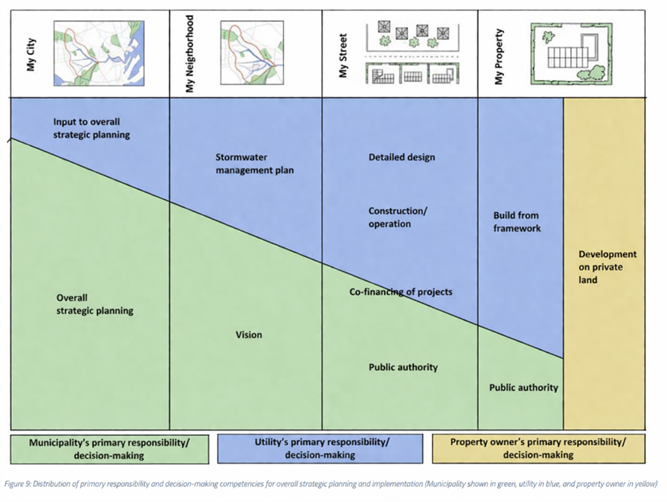
Roles and responsibilities across planning scales in stormwater management
Urban stormwater management is a “wicked problem,” requiring integration across sectors, institutions, and spatial scales. Hence, Nature‑Based Solutions (NBS) and stormwater management require not only coordination across sectors, but also a clear understanding of how ownership shifts across spatial planning scales. Something that can effectively be supported through “mission management” as a tool. A key feature of mission management is the recognition that ownership is not fixed but shifts as planning moves from one scale to another.
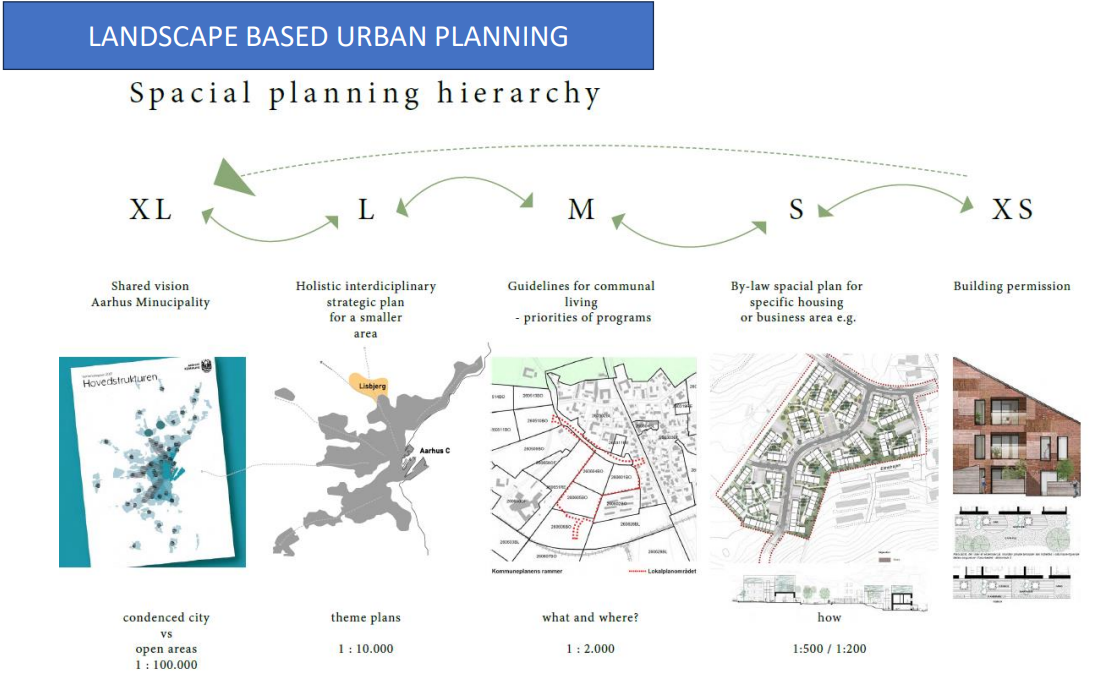
Water management on all planning levels
At the XL-scale (city or catchment level), project ownership is predominantly situated within municipal councils and regional planning authorities, who articulate the overarching strategic vision, long‑term policy goals, and mission‑level ambitions for climate adaptation, biodiversity enhancement, and flood resilience. At this scale municipal actors formulate integrated spatial and hydrological principles that position stormwater as an inherent component of broader urban system dynamics, including land‑use regulation, ecological connectivity, and resilience planning. Consequently, the XL‑scale serves as the planning-step where cross‑sector policy objectives are coordinated and translated into landscape‑level strategies that guide subsequent planning and implementation across the lower spatial tiers.
As planning transitions to t L‑scale (master planning or sub-catchment level), project ownership becomes increasingly distributed, engaging utilities, local environmental agencies, and landscape planners who translate high‑level strategic intentions into spatial frameworks and system‑level design principles. At the L‑scale, ownership is typically consolidated within utilities and municipal water authorities and city planning departments, who assume responsibility for aligning catchment‑based stormwater disposition plans with infrastructural requirements, regulatory obligations, and broader environmental management objectives.
At the medium scale (M), project ownership typically undergoes a further shift toward interdisciplinary teams charged with district‑level implementation. At this scale, strategic ambitions are systematically translated into spatial masterplans and “blue‑green design frameworks” that integrate Nature‑Based Solutions (NBS), local stormwater management strategies, mobility planning, and broader urban development objectives.”
Finally, at the small scale (S), ownership is primarily in the hands of site‑specific actors, e.g., property owners, housing associations, developers, and local communities, who implement and maintain (in Dk the Utility is responsible for implementation and O&M) individual NBS elements (stormwater management solutions) such as rain gardens, swales, green recreation spaces, or localized flood routes.
“Place/Space Making” and Its Importance
In addition to shifting ownership across scales, effective NBS and stormwater management depend on a strong focus on place‑making and space‑making. These concepts emphasize that stormwater solutions are not merely technical infrastructures, but spatial interventions that shape how people experience, use, and value their surroundings. Place‑making ensures that NBS are embedded in meaningful local contexts, reflecting cultural identity, landscape character, and everyday practices, rather than being perceived as isolated engineering add‑ons.
At larger planning scales, space‑making establishes the spatial logic and physical frameworks that link stormwater corridors, blue‑green networks, and ecological structures across the urban landscape. At smaller scales, place‑making activates these spaces socially, ensuring they become attractive, functional, and care-for components of the local environment. This social anchoring is critical: when citizens perceive stormwater landscapes as high‑quality places, they are more willing to support, maintain, and co‑own the solutions.
By integrating place/space making, planners ensure that NBS simultaneously deliver hydrological function, ecological value, and social meaning. This strengthens the legitimacy of interventions and aligns diverse actors around shared spatial qualities. Mission management plays a key role here by maintaining coherence between large‑scale spatial intentions and small‑scale place‑based implementation, ensuring that each intervention contributes to a recognisable, functional, and identity‑creating blue‑green landscape.
Mission management – Transition of roles and responsibilities
Mission management ensures these transitions happen without fragmentation by creating a shared narrative, shared governance tools, and alignment between the actors at each scale. Because stormwater management touches landowners, planners, utilities, and citizens differently at each planning scale, a mission‑driven approach provides the connective tissue that keeps the overall purpose intact. It reinforces accountability: who sets the direction, who designs, who delivers, and who maintains. By clarifying ownership shifts early, cities can reduce friction, accelerate decision‑making, and ensure that NBS do not lose coherence as they move from vision to construction.
This multiscale mission structure also supports adaptive learning. At larger scales, feedback from small‑scale projects can be used to refine strategies, adjust priorities, or introduce new governance mechanisms. At smaller scales, mission management ensures that local interventions contribute to broader system goals such as biodiversity corridors, cloudburst routing, groundwater protection, or recreational connectivity.
Ultimately, mission management provides a stable framework in which inevitable shifts in ownership become a strength rather than a barrier, while maintaining coherence across planning scales. It enables a transition from fragmented responsibilities to a more integrated and collaborative approach to stormwater management. By ensuring that each planning scale—from XL to S—contributes uniquely to a shared vision, mission management aligns strategy, planning, and implementation. In doing so, it transforms Nature-Based Solutions (NBS) from isolated interventions into a systemic and resilient transformation of the urban landscape, unlocking their full potential in urban water systems.