
Nature Based Solutions (NBS) have proven to be meaningful for cities in various ways. They are known for creating pleasant microclimate, they can enhance urban aesthetics, create opportunities for recreation, and promote the health and wellbeing of the local communities. The term NBS encompasses a wide range of interventions (scaling from green roofs to large wetlands), out of which not all are relevant for urban stormwater management at the catchment scale.
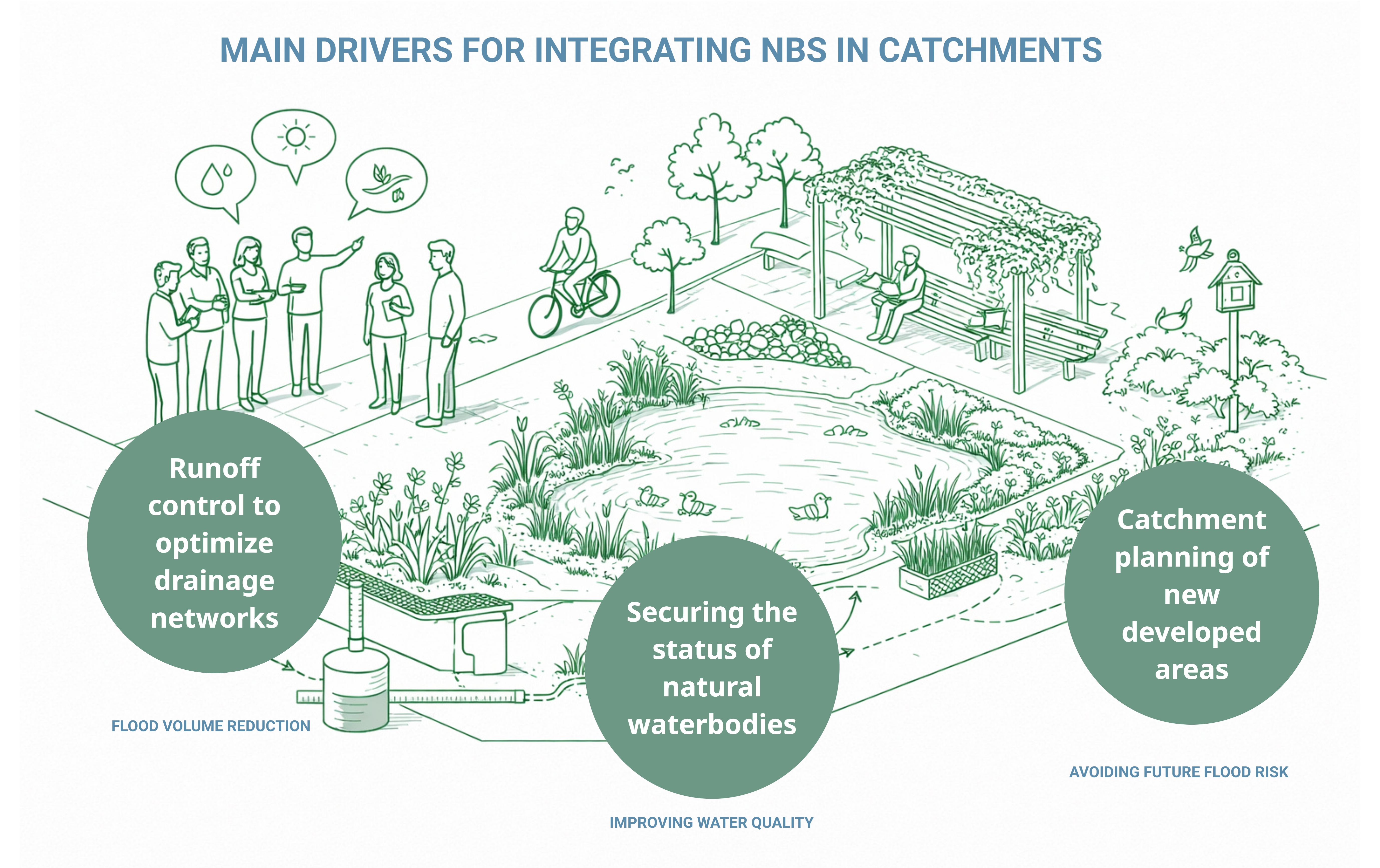
In the NBS model we focus on planning and implementing such NBS that are designed as catchment-fit (Figure 1) and thereby are either:
- increasing the resilience of current urban drainage systems and mitigating the flood risk of existing built-up areas,
- improving water quality in the receiving natural waterbodies for ecological purposes, or
- mitigating the future flood risk and optimizing drainage systems for newly developed areas.
The examples presented in the NBS Model have been collected through the City Blues project. They are intended to inspire and guide, but not to prescribe a single pathway. Mainstreaming catchment-fit NBS requires adapting approaches to local contexts, capacities, and governance systems.
How the NBS model was developed?
City Blues project set an ambition to develop a Joint Operational Model (JOM) for the development of Nature Based Solutions (NBS) for resilient urban catchments. The operational model was meant to serve as guidance source for local governments, infrastructure and public service providers to help select suitable strategies in implementing NBS. The initial idea of the JOM aimed to cover themes like planning of NBS, risk management, maintenance plans, citizen and stakeholder engagement, governance models and actual pilots and be visualized as a process chart.
During the development of JOM we acknowledged that all 5 piloting cities differ by their previous experiences with climate extremes, their entry level capacities and knowledge pool on NBS, their financial capacity in investing into NBS and related developments. Moreover, while cities have similarities in their local governance models, the socio-political contexts as well as legislative frameworks differ significantly.
During the peer learning, expert exchanges and joint workshops, we have mapped both the joint principles as well as differences in operational contexts. Moreover, while doing this we have always aimed to make the operational model relevant for Baltic Sea Region (BSR) cities beyond consortium. Meaning the pertinence of the guidance should be recognized by cities with no previous experience with NBS as well as by cities leading the way in NBS implementation in BSR.
Intergrated governance of cachment-fit NBS in cities
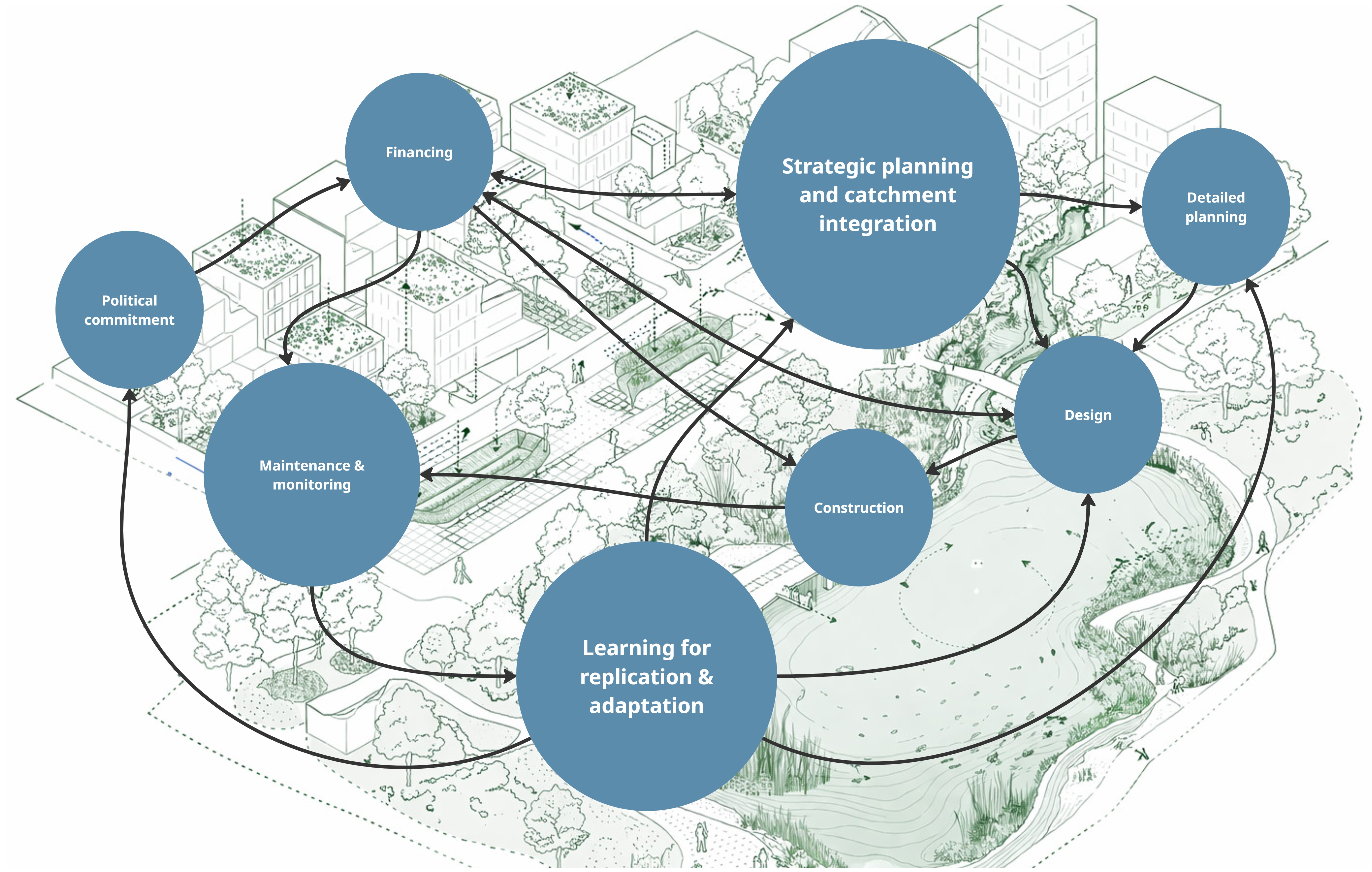
Catchment-fit NBS are enabled by collaboration of different stakeholders and integrated governance.While the key stakeholders differ depending from the policy models as well as the main objective triggering the need to integrate NBS into an urban catchment, such a solution can not be effectively delivered unlessintegrating spatial planning, environmental and sewage network performance goals. In addition such NBS can not be implemented successfully unless coordinated across their evolving lifecycle (from planning – constructing – maintenance – adapting). This typically requires commitment from different municipal departments, water utilities but also local communities, developers and landowners therefore it must be integrated into different municipal functions (Figure 2).
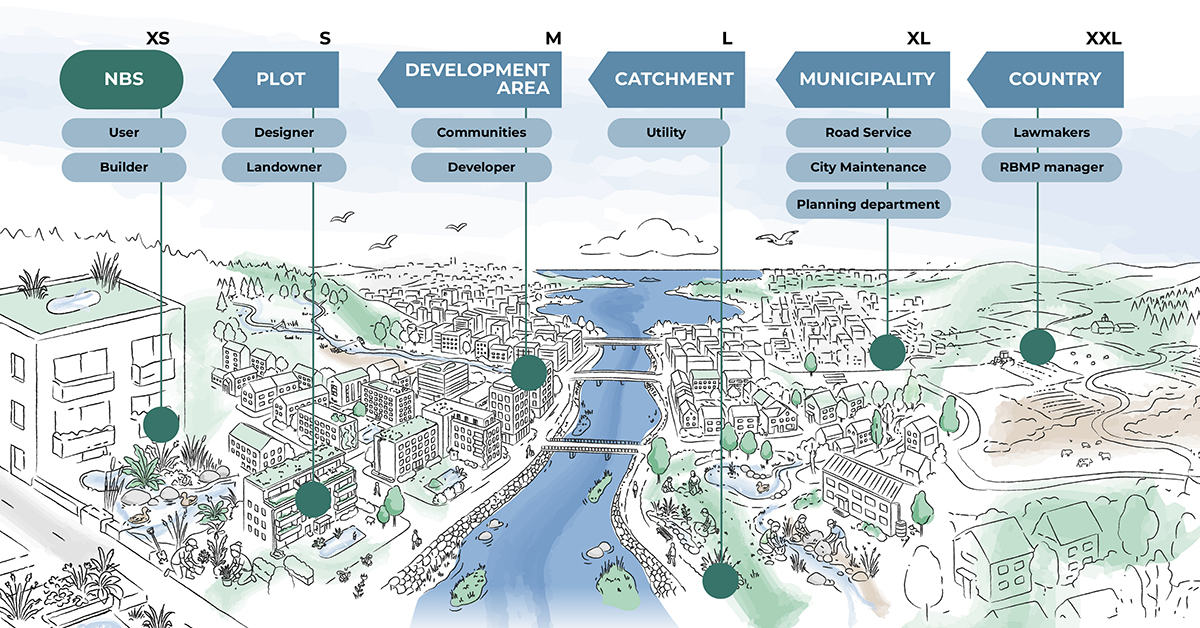
As if it was not complex enough, the integration needs to happen across different urban scales. When planning a plot-scale solution, it needs to be meaningful in catchment level, fit to the neighbourhood, align with other infrastructure and follow the masterplan (Figure 3).
While this integrated approach may seem straightforward in theory, in practice it is often complex. Governance arrangements are frequently fragmented, and coordination across institutions remains a key challenge – or actually a mission. Cities representing City Blues see the integrated multi-stakeholder, multi-scale, multi-context governance of catchment-fit NBS as a mission. This requires committed mission holders and continuous willingness to adapt, learn and improve. Even the most advanced cities in the project identified gaps and opportunities for improvement.
At the same time, simpler, practical solutions – “quick wins” or governance hacks – can help less experienced cities take their first steps in setting up their mission. There is no one-size-fits-all solution, but different pathways towards the joint operational logic, which we present under NBS model guidance.