
Risk management
We’re still building this page brick by brick. Stay tuned for the grand reveal!
NBS-related risks are twofold: risks that are treated with NBS, including risks to climate resilience, biodiversity, and human health that can be managed through Nature-Based Solutions and governance & operational risks that are managed in NBS project lifecycle. City Blues project uses the international risk management standard (ISO 31000:2018 - Risk management — Guidelines), which covers i.e. risk assessment, management, communication and reporting. However the City Blues project partners have notices, that the standard does not completely match current practices in the cities as the risk evaluation part is often missed.
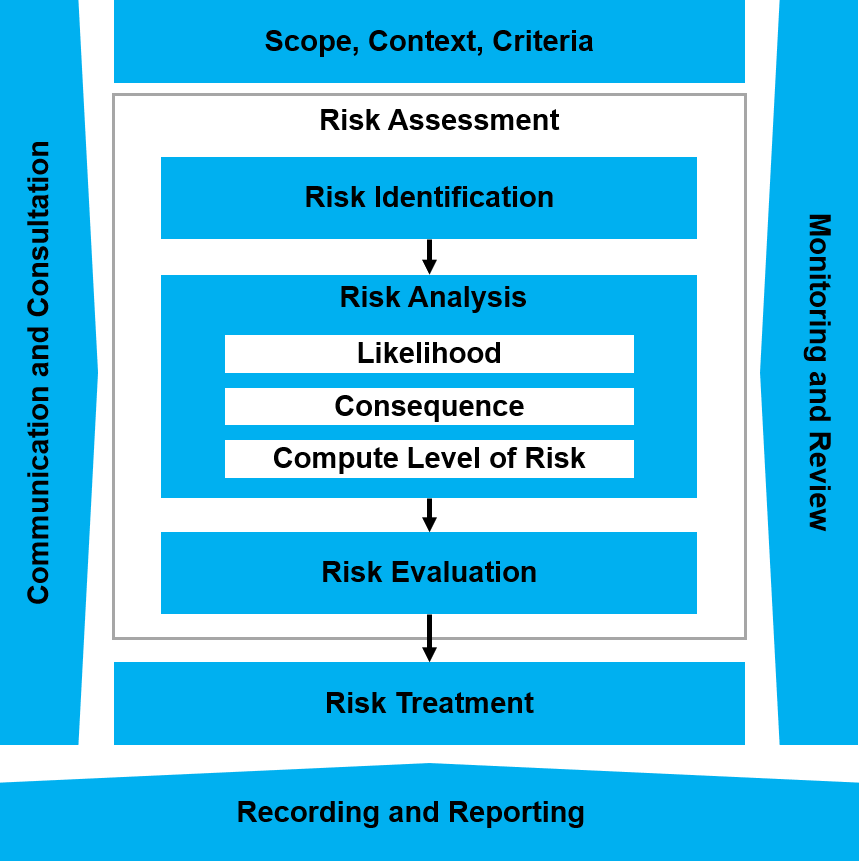
Risks that are treated with NBS
-
Pluvial (rainfall‑driven) and fluvial (river‑driven) flood risks are major challenges in many cities. NBS such as wetlands, restored streams, ponds and green corridors help reduce these risks by detaining, slowing or storing water. Cities in the City Blues project use models, monitoring and historic event analyses to understand flooding and target NBS effectively.
Examples
- Aarhus uses river and urban catchment models together with risk maps for several return periods ranging from 5‑year to 100‑year events, updated every five years. The city also documents historic events using radar data and compares them with model results to establish a reliable baseline.
- Malmö relies on its city‑wide GIS model (Mike+) to visualize the highest water levels and uses Scalgo Live to identify natural flow paths and low points. The city has also studied historic riverbeds and floodplains to understand where water historically tended to accumulate.
- Tampere has nine main catchment areas and has developed stormwater management plans for two of them. Its stormwater network model is calibrated with real monitoring data. The city records historic flood incidents and notes that modelled and real‑world flooding do not always match, highlighting the importance of continuous data collection. Tampere also uses real‑time flow and precipitation monitoring and performs manual lake level measurements.
- Tartu has documented the impacts of a major flooding event on 6 August 2024, which supports future NBS planning.
Tips
- Combine modelling with real historic flood data.
- Integrate models into up‑to‑date GIS systems.
- Use real‑time monitoring to support early warning.
- Study historic water flow paths to guide NBS placement.
-
Coastal cities and cities along major rivers face long‑term risks from sea level rise and extreme river flooding. NBS such as coastal wetlands, natural floodplains and vegetated shorelines can reduce exposure and increase resilience.
Examples
- Aarhus applies national sea‑level rise projections and storm surge data when planning for coastal risks. The city is developing a municipal‑scale coastal strategy based on a DAPP‑inspired (Dynamic Adaptive Policy Pathways) risk analysis approach.
- Malmö identifies sea level rise as its key climate challenge and uses both national and local models to project future conditions. The city has adopted a Coastal Protection Strategy covering the years 2025–2125.
- Tartu notes national mapping for the flood risks of the Emajõgi River.
Tips
- Use national and local sea‑level rise modelling in planning.
- Develop long‑term coastal strategies.
- Protect or restore natural coastal habitats to buffer flood impacts.
-
Cities can become significantly warmer than their surroundings during heatwaves. NBS, like green areas and green roofs help cool urban environments, improve comfort and reduce health risks.
Examples
- Malmö has performed detailed climate analyses, starting with discomfort index and ground temperature assessments after the 2018 heatwave. The city created Solweig maps showing mean radiant temperature under future scenarios and conducted microclimate modelling for new development areas using PET. Malmö also modelled how heat affects urban trees.
- Tampere relies on national GIS datasets documenting heat islands during historic heatwaves.
Tips
- Use modelling to demonstrate the impact of urban heat.
- Design NBS to withstand drought and heat stress.
- Place cooling NBS in identified heat island zones.
-
Urban development often reduces habitats and threatens species. NBS can protect or restore nature in cities by enhancing habitats, restoring natural waterways, and strengthening green‑blue networks that support species movement and ecological resilience.
Examples
- Aarhus emphasizes preserving and restoring natural streams and ponds because they are more resilient to stormwater surges and drought and support more species.
- Malmö is developing a method to map and model ecosystem services to support planning and compensation work.
- Tampere uses existing biodiversity data and conducts endangered species surveys such as flying squirrel assessments.
- Tartu’s Biodiversity Strategy highlights the need to mitigate biodiversity risks.
Tips
- Prioritize preserving natural habitats.
- Map and document species and integrate this data in GIS.
- Use biodiversity strategies to guide NBS placement.
- Strengthen green‑blue network connectivity.
-
Stormwater can carry pollutants that degrade streams and lakes. NBS can improve water quality by filtering stormwater, but they must be used carefully, as they are not suitable for severely contaminated water.
Examples
- Malmö and Tampere both use the StormTac model to assess stormwater pollution risks.
- Tampere also has real‑time monitoring with sensors and performs comprehensive water sampling in streams and lakes. Its stormwater program identifies sources of emissions within catchments. The document notes that NBS should not be implemented where water is heavily contaminated.
Tips
- Apply pollution modelling before selecting NBS locations.
- Avoid placing NBS in areas with highly contaminated water.
- Identify vulnerable water bodies and potential pollution sources.
- Monitor water quality over time.
Governance and operational risks
-
Risk management has to be integrated in relevant plans and strategic documents to guide how the city should work with climate risks. If different departments work separately, or if there’s not enough political support, projects can stall. Other risks are conflict between NBS solutions and other objectives that a city has, insufficient commitment to objectives and the cyclical nature of political decision-making, lack of knowledge on NBS and capacity to explain their purpose and functions to politicians and wider public., and not following general plans or EU regulations.
Examples
- Malmö follows Sweden’s law stating that climate risks such as flooding, erosion and landslides have to be considered in new development areas so it is an integrated part of Malmö’s land use planning. Cities still experience a loss of green space, so preserving existing green areas is the most cost-effective risk management and should be an integral part of any plans.
- In Stavanger, laws require NBS, but coordinating with other departments is a challenge.
- In Tampere, conflicts between NBS and other city goals, and changing political priorities, can slow progress.
Tips
- Make risk management part of all key city plans.
- Preserve existing green areas whenever possible.
- Encourage departments to work together, not in silos.
- Clearly explain permitting processes and why NBS are important.
- Use connection permits to set requirements for new developments.
-
One big risk related to financing NBS is the unforeseen costs throughtout the lifespan of the solution. There can also be a lack of information and experience about the potential costs, and a challenge with getting private sector on board. Funding must be secured for the entire NBS life cycle, but the right amount can be impossible to allocate. Therefore continuous funding through wastewater taxes or stormwater fee helps minimize risks the best.
Examples
- In Aarhus, the utility company funds NBS projects through wastewater taxes and connection fees.
- In Malmö, stormwater management is funded by the utility, but in older areas, property owners are responsible and participation is voluntary.
- In Tampere, it’s hard to guarantee funding for the whole NBS life cycle in projects especially, and maintenance can be expensive. The city collects stormwater fee to fund solutions.
- In Stavanger, there’s little experience with the real costs, and it’s hard to get private partners involved.
Tips
- Clarify who owns and is responsible for each part of the project.
- Plan for all costs, including monitoring and stakeholder engagement.
- Prepare for surprises and do thorough planning before starting.
- Secure funding for the entire life cycle, not just the build phase.
- Consider new funding models and clearer rules.
-
Finding space for new NBS sites can be difficult, especially in older city areas. Other factors like infrastructure, natural values, and invasive species can complicate planning and increase costs. Reconciliation is always a compromise, and not all objectives can necessarily be achieved. Good planning requires expertise and collaboration from many people.
Examples
- Aarhus plans NBS at several scales to make sure solutions are in the right place and size.
- Malmö uses technical handbooks and design guidelines to ensure risks are considered at every stage.
- In Tartu, new developments sometimes don’t follow the comprehensive plan, which can create risks.
Tips
- Start with a thorough investigation phase.
- Use a string of plans: city-wide green-blue networks, catchment plans, and development plans.
- Reserve space for stormwater treatment in masterplans.
- Blend technical and ecological expertise.
- Consider cross-boundary water issues early.
-
Design risks relate to not knowing how to design NBS properly to work in different conditions and have them provide multiple benefits as they should. Designing the NBS performance for variable flood settings is already a state of the art, however less knowledge is available. Guidelines exist for different NBS (e.g. volume of detention ponds due to experience of previous failures of smaller systems) and city specific design manuals and technical handbooks with previous experiences help lower design risks.
Examples
- Malmö uses technical handbooks and guidelines to ensure NBS can be maintained.
- In Tampere, planning for rare events can reduce everyday benefits, and models don’t always match reality, so measurement is important.
- In Tartu, limited experience means utilities don’t always trust NBS.
Tips
- Use available guidelines and checklists.
- Build in feedback loops from monitoring and maintenance.
- Test model assumptions with real measurements.
- Design for both performance and easy maintenance.
-
Construction risks include soil contamination, choosing the right contractor, unexpected findings, community conflicts (like noise or traffic), and coordination with other infrastructure. Sometimes, structures aren’t built as planned, which affects how well they work. Construction can also cause pollution.
Tips
- Choose contractors based on quality and knowledge on NBS, not just price.
- Plan for surprises and coordinate with other infrastructure.
- Make sure builders follow plans closely.
- Manage pollution risks during construction.
- Communicate with the community about possible disruptions.
-
Efficient monitoring requires good baseline data. Risk is a lack of knowledge on how to monitor and follow the solution against the baseline. Another risk is seasonal variability (how many times the maintenance need to take place). Maintenance plans need to have different up to date scenarios for different seasons. Invasive species management plan needs to be integrated to the maintenance plans.
Tips
- Create clear maintenance plans for different seasons.
- Integrate invasive species management into maintenance.
- Assign clear responsibilities for maintenance.
- Anticipate possible surprises, like protected species or groundwater issues.
-
Monitoring should focus on what the NBS was designed to do, and access to private sites may be needed. Long-term monitoring is important, especially for rare events like major floods. Risks relate for example in the trustworthiness of the devices. For instance, inexpensive sensors may not necessarily work. You need to test in real urban environment. Also not all monitoring devices withstand the Nordic climate. Maintaining measuring devices also takes time and money.
Tips
- Plan and fund monitoring for the long term.
- Make sure you can access all sites that need monitoring.
- Monitor the parameters that matter most for your goals.
- Use monitoring results to improve future projects.
-
Stakeholder risks refer to challenges that arise from the involvement, interests, and influence of different groups or individuals in NBS projects. These risks can affect project planning, implementation, and long-term success if not properly identified and managed.
Stakeholder risk identification tips
- Map stakeholders early through project investigations and stakeholder mapping workshops. See more guidance for stakeholder mapping on the Stakeholder management section.
- Engage with both public and private interests to clarify roles, responsibilities, and expectations from the start.
- Use stakeholder analysis to highlight those most affected, those with the greatest impact, and those responsible for action.
- Include technical stakeholders like utility companies and infrastructure owners at the planning stage before construction to minimize surprises.
- Set up clear feedback channels, such as dedicated contact persons, information boards, and online forms, to capture concerns as they arise.
- Coordinate with other ongoing projects in the area to spot overlapping risks and avoid confusion.
Stakeholder risk examples
- Disagreement on problem scope (catchment vs local plot)
- Low trust and negative past experiences
- Participation fatigue (e.g. surveys, events, reporting problems)
- Unequal voice of stakeholder groups
- Unrealistic perception on future maintenance periods
- Unclear maintenance responsibility
- Resistance to land-use change
- Legal, liability and safety concerns
- Aesthetic expectations (“messy” vegetation vs community norms)
- Vandalism or misuse
- Contractor capability gaps
- Disruption to daily life (noise, traffic etc.)
Stakeholder risk analysis
Stakeholder risk analysis can be done by categorizing identified risks based on their likelihood and severity. On the previous list City Blues partners analysed most and less likely risks.
Most likely stakeholder risks
- Disruption to daily life: high in urban areas or residential areas. Construction or implementation of NBS interventions such as urban green streets, wetlands, retention/rainwater basins, or river restoration can temporarily disrupt residents, businesses, and commuters through noise, dust, traffic detours, or restricted access. If poorly managed, this can lead to complaints, negative perceptions, and opposition, slowing project delivery.
- Participation fatigue: Repeated and poorly coordinated engagement across multiple NBS and climate projects leads to stakeholder participation fatigue, reducing engagement quality and increasing the risk of late-stage resistance.
- Unequal voice among stakeholders: high in especially in projects with many stakeholders but limited facilitation resources. Dominance of well-organized groups in engagement processes may silence smaller or less-connected stakeholders, leading to inequitable outcomes and potential resistance. Public hearing and directly impacted parts are involved directly)
- Resistance to land use change: medium to high in stakeholders, especially farmers and landowners, may resist land-use changes required for NBS (e.g., wetlands, river restoration) due to perceived loss of productive land, income, or traditional use. This can delay projects, increase costs, and reduce ecological effectiveness. Urban stakeholders may resist land-use changes for climate adaptation (e.g., green spaces, retention areas) due to perceived loss of space or parking space, inconvenience, or aesthetic concerns, delaying projects and reducing acceptance.
Less likely stakeholder risks
- Disagreement on problem scope (catchment vs local plot)
- Vandalism or misuse
- Unrealistic perception on maintenance responsibility
Risk mitigation strategies
- Disagreement on problem scope (catchment vs local plot)
- Facilitate early workshops to align on scale, use visual models to show local vs catchment benefits, adopt layered planning (catchment plan + local measures), highlight shared benefits, use adaptive governance.
- Low trust and negative past experiences
- Transparent communication, acknowledge past issues, show tangible results via pilot projects, involve trusted intermediaries, clarify compensation and maintenance responsibilities, create iterative feedback loops.
- Participation fatigue (e.g. surveys, events, reporting problems)
- Limit the number of surveys/events, consolidate engagement activities, show how input influences decisions, rotate responsibilities among stakeholder groups, provide feedback on outcomes.
- Coordinate different activities across departments and areas of expertise, e.g. information about NBS together with spatial planning engagement.
- Unequal voice of stakeholder groups
- Ensure inclusive engagement, actively reach out to underrepresented stakeholders, use structured decision-making workshops, balance influence in advisory committees.
- A stakeholder analysis gives a better understanding of whom to interact with.
- Direct outreach (door‑knocking), meetings, on‑site posters, and open communication channels to include all stakeholders.
- Unrealistic perception on future maintenance periods
- Clearly define maintenance responsibilities, communicate funding limitations and duration, provide written agreements, explain adaptive maintenance needs, use signage or guidance for private features.
- Explaining the need for a messy more natural site by e.g. signs
- Unclear maintenance responsibility
- In Malmö this is handled between the utility and the technical department.
- In Stavanger contractor is responsible for 5‑year maintenance, clear inspections and reporting. Installed a snow‑melting system to avoid salt damage and reduce long‑term maintenance risk.
- Resistance to land-use change
- Offer fair compensation, early consultation with landowners, provide flexible design options, pilot demonstration sites, communicate ecological and flood-risk benefits. Cost-benefit analysis as communication tool
- In Malmö residents are often welcoming more space for recreation on public land. Slow transition and previous examples help. Influencing landowners/property owners to implement measures on their own land is harder.
- Practical solutions for deliveries and access, satisfy local business requirements.
- Technical stakeholders and politics have accepted the project before construction.
- Legal, liability and safety concerns
- Define responsibilities and liabilities clearly in contracts, conduct safety audits, include protective infrastructure (fencing, signage), ensure insurance coverage, communicate rules and potential risks.
- Geofenced speed reductions and keep dialogue with mobility companies and traffic authorities.
- Aesthetic expectations (“messy” vegetation vs community norms)
- Early engagement to explain design, use visual simulations/pilot sites, mix functional and aesthetic designs, explain seasonal changes, provide educational signage.
- In Stavanger, place quality was assessed through the use of the Living Lab Pallet Park, to set visual expectations
- Vandalism or misuse
- Design for resilience (durable materials, robust planting), provide clear signage, engage the community to encourage stewardship, regular monitoring, fencing or access control where needed.
- Contractor capability gaps
- Pre-qualify contractors with relevant experience, provide training or supervision, use pilot projects or phased implementation, include clear technical specifications and monitoring, use performance guarantees.
- Ensure contractors have relevant NBS experience through pre-qualification, training, and pilot projects. Provide clear technical specifications, supervision, and performance-based contracts. Encourage collaboration with ecological specialists and document lessons learned to build long-term capacity.
- Implement a detailed maintenance plan. Use proper materials and construction methods (local stone, soil layers).
- Disruption to daily life (noise, traffic etc.)
- Schedule work during off-peak hours, provide advance communication and signage, offer alternative routes, and limit construction duration. Similar practices apply as in other construction work.
- Dedicated contact person, on‑site info/QR, door‑to‑door visits; maintain access for deliveries and pedestrians. Coordinate with the adjacent projects to avoid disruptions and align schedules.